 SaaS
SaaSCase study · SaaS
Go Bridgit: Contractor Management SaaS · Enterprise SEO at 2,500+ URLs
I led technical SEO and large-scale on-page remediation for Go Bridgit’s contractor management SaaS: audited the stack, implemented prioritized fixes with engineering, manually optimized meta titles and descriptions across 2,500 pages, and audited all 2,254 blog URLs in Ahrefs, Google Keyword Planner, and Screaming Frog. Deliverables included a duplicate-content plan, a zero-traffic legacy matrix, 404-to-live redirect mapping, selective blog retirement with 301s to topical hubs, and an engineering playbook to eliminate redirect chains—validated with Gmetrics, Pingdom, and ongoing GSC monitoring. Related reading: Technical SEO: Crawling, Indexing, and Site Architecture. Related reading: How I Cut Crawl Budget Waste by 38% Without Adding Server Capacity. For reference, see Google Search Console performance report help. For reference, see HubSpot’s SEO marketing guide.
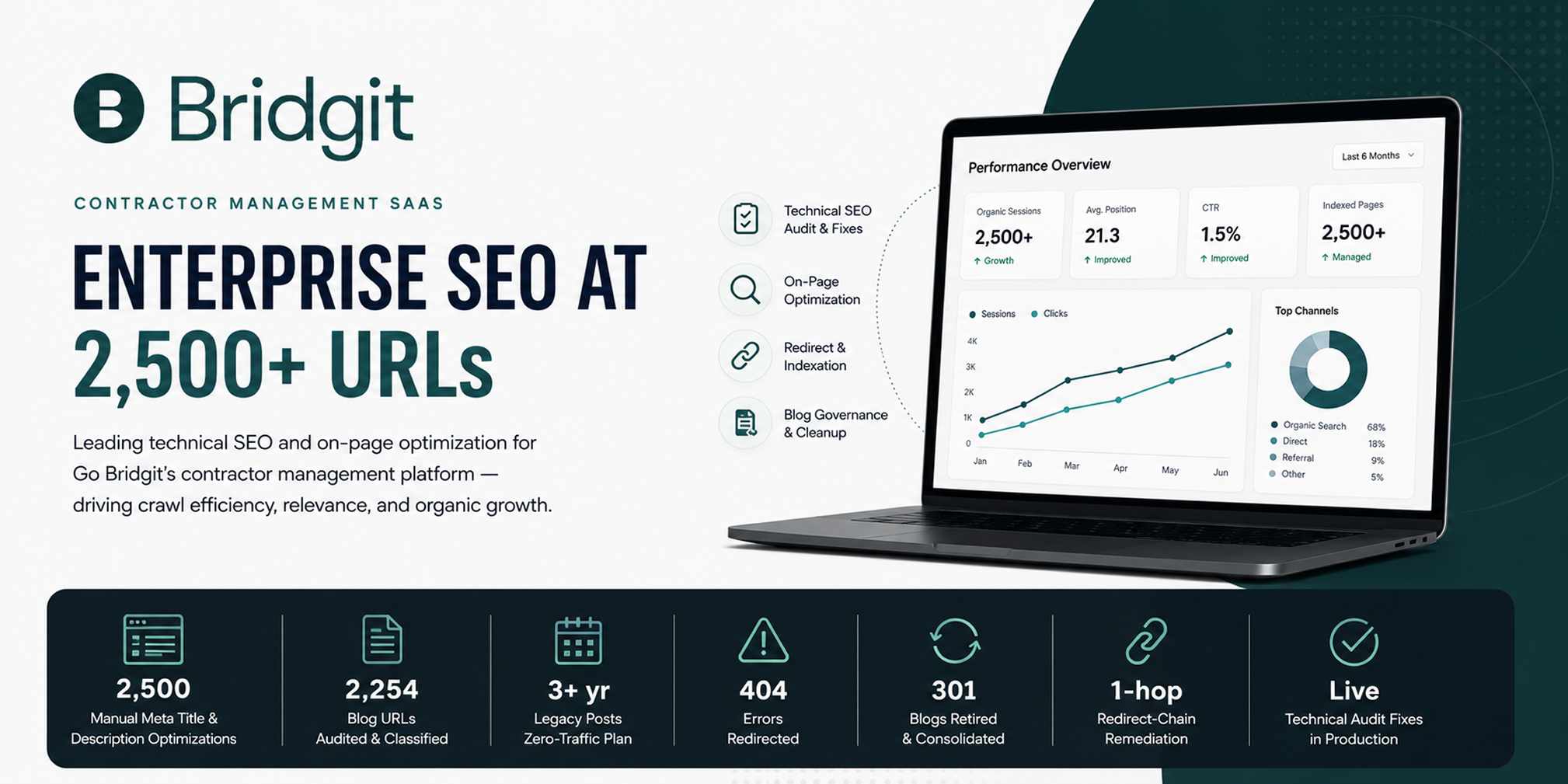
2,500
Manual meta title & description optimizations
2,254
Blog URLs · audited & classified
3+ yr
Legacy posts · zero-traffic plan
404
Errors · intent-matched redirects
301
Retired blogs · hub consolidation
1-hop
Redirect-chain remediation spec
Live
Technical audit fixes in production
GSC & GA4 metrics where client permitted
Challenge
- Thousands of URLs without a governed meta standard for contractor-management search intent
- Blog scale creating duplicate clusters that competed with SaaS product and integration templates
- Three-year-old articles with no measurable traffic still indexed and consuming crawl budget
- 404 backlog with no mapping to feature, pricing, documentation, or resource destinations
- Redirect chains and weak internal links delaying equity to demo and trial conversion pages
- Performance and uptime risk on template-heavy marketing URLs without a consistent monitoring baseline
Strategy
Treat the site like a B2B SaaS content system, not a media blog: close technical debt and redirect architecture first, align every indexable URL to contractor-ops queries with hand-reviewed meta, then rightsize the blog—merge duplicates, refresh posts that still match the platform narrative, and retire or 301 everything that wastes crawl budget without supporting pipeline pages.
Execution
Phase 1 · Technical foundation
- End-to-end technical SEO audit—crawlability, indexation, canonicals, status codes, internal links, and template-level performance
- Implemented prioritized fixes with Go Bridgit engineering; tracked resolution in a shared fix log
- Baseline monitoring with Gmetrics and Pingdom; crawl validation in Screaming Frog after each release wave
- Redirect-chain remediation spec for engineering—single-hop 301s, chain flattening, and internal-link QA to prevent regressions
Phase 2 · Sitewide on-page (2,500 pages)
- Manually rewrote meta titles and descriptions for all ~2,500 indexable pages—editorial QA on every template class, not bulk auto-generation
- Validated priority URLs against Google Keyword Planner and Ahrefs—query-to-page fit for contractor ops, compliance, and field-management themes
- Aligned snippets to product, pricing, integrations, and demo paths so organic listings reflected the SaaS value proposition
Phase 3 · Blog governance (2,254 articles)
- Classified the full blog corpus—GSC clicks, Ahrefs traffic value, backlink profile, duplication clusters, and topical overlap with money pages
- Published a duplicate-content remediation plan—merge, canonicalize, refresh, or retire, each URL with an owner and deadline
- Flagged posts older than three years with zero traffic—optimization briefs vs. redirect targets tied to live hub pages
- Retired off-target and thin articles that wasted crawl budget; 301 consolidated equity into relevant category and product hubs
- Mapped 404 errors to the closest live URL by search intent—never blind homepage redirects
Results
Go Bridgit shifted from an unmanaged content archive to a governed SEO program for its contractor management platform. Technical issues from the audit shipped to production; redirect chains were documented so link equity reached product and demo URLs in one hop; and 404s were resolved with intent-matched destinations instead of catch-all redirects. Hand-optimized meta across 2,500 pages tightened SERP relevance for construction-operations queries, while the 2,254-post blog audit gave marketing and engineering a single backlog—duplicate clusters to merge, legacy zero-traffic URLs to refresh or redirect, and off-target posts removed so crawl budget returned to feature, pricing, and signup templates. Ongoing measurement in GSC, Ahrefs, Gmetrics, and Pingdom gives the team leading indicators—cleaner crawls, fewer soft-404 patterns, and a content roadmap tied to SaaS conversion paths rather than blog volume alone.
Related services
How I deliver similar work as an SEO contractor—without repeating article links from the case narrative above.
Technical SEO AuditOn-Page OptimizationRedirection MappingWebsite MigrationContent Clustering & Keyword MappingOrganic Growth Roadmaps & SEO Architecture
Deliverables
- Technical SEO audit & production fix log
- Manual meta optimization pack (~2,500 pages)
- Blog corpus analysis workbook (2,254 URLs)
- Duplicate-content remediation plan (owners & deadlines)
- 3+ year zero-traffic matrix (optimize vs. redirect)
- 404 → intent-matched redirect map
- Blog retirement & 301 consolidation list
- Redirect-chain & internal-linking engineering spec
- GSC & Ahrefs monitoring cadence
Tools used
AhrefsGoogle Keyword PlannerScreaming FrogGSCGmetricsPingdomGA4
“Our marketing site had outgrown our SEO process—thousands of URLs, no clear crawl priorities, and a blog that competed with our product pages. Hrayr delivered an audit our engineers could ship, meta that finally describes our contractor management platform in search, and a disciplined plan for which of 2,254 posts still deserve to exist.”