 Local SEO
Case study · Local SEO
Global Auto Transportation: 18K-URL USA Rebuild · 450 to 3,500 Sessions in 5 Months
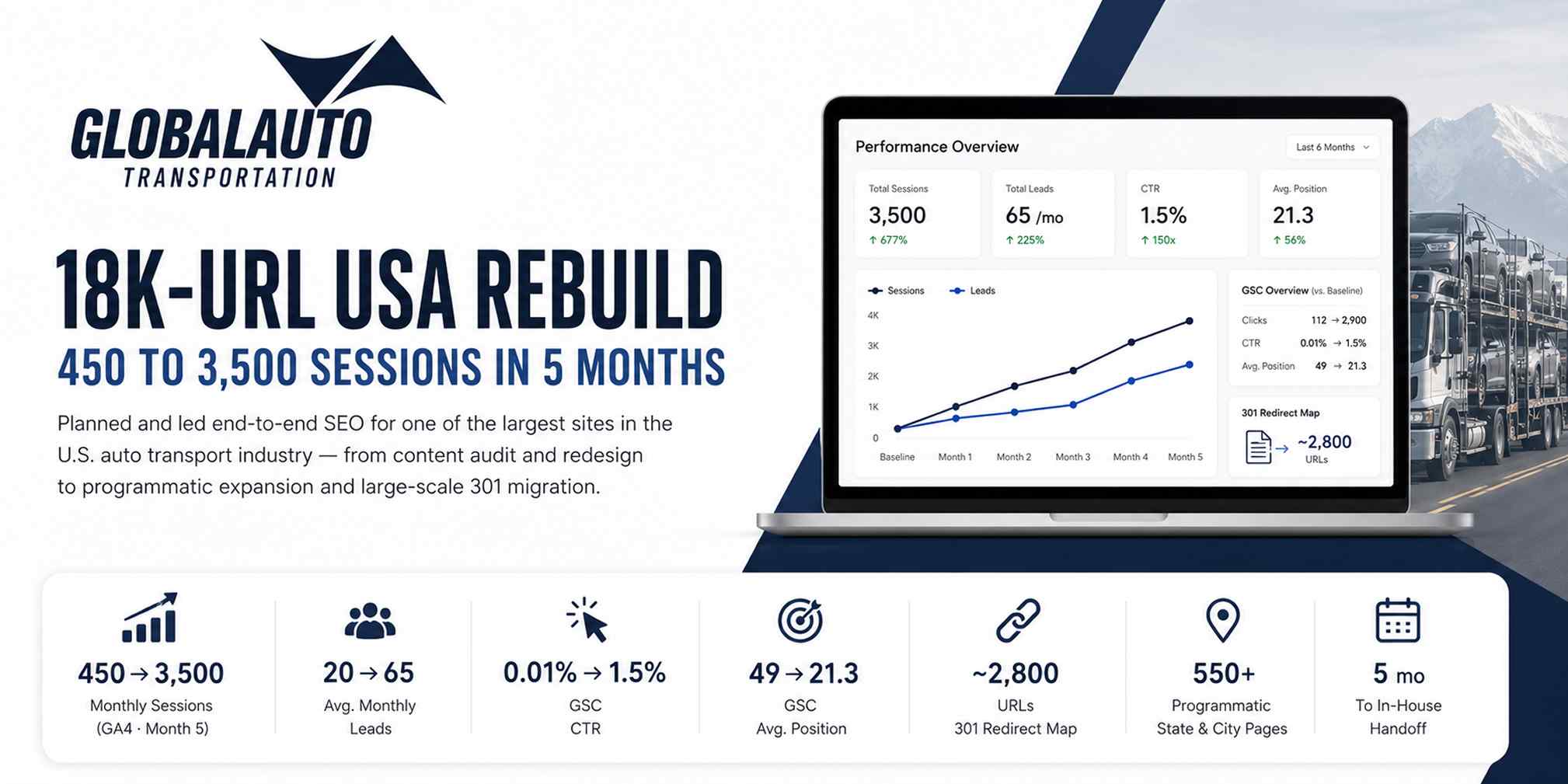
I planned and led SEO for one of the largest sites I have managed: on-page content audit first, then redesign collaboration with UX and engineering for conversion and E-E-A-T (blog author bios linked to LinkedIn). I built programmatic state and city architecture—50 U.S. states plus 10 city pages per state—created and optimized all landing pages, and took over UI design after the in-house designer left on day five. I delivered a 301 map for ~2,800 legacy URLs (2,500 off-niche + ~300 zero-traffic duplicates) that frontend automated. Baseline was ~450 monthly sessions, 30s engagement, 20 leads, and 112 GSC clicks at 0.01% CTR and position 49; by month five: 3,500 sessions, 65 leads/month, 1.5% CTR, and position 21.3—the team then continued in-house. For reference, see Google Search Console performance report help. For reference, see HubSpot’s SEO marketing guide.
450→3,500
Monthly sessions (GA4 · mo. 5)
20→65
Avg. monthly leads
0.01%→1.5%
GSC CTR
49→21.3
GSC avg. position
~2,800
URLs · 301 redirect map
550+
Programmatic state & city pages
5 mo
To in-house handoff
GSC & GA4 metrics where client permitted
Challenge
- 18,000-page legacy site with no redesign or content strategy since 2009
- Under 900 monthly GA4 sessions despite 18 years in the U.S. auto transport market
- ~2,500 URLs off-niche (politics, HVAC, etc.) diluting topical authority and crawl budget
- ~300 aged URLs live 8+ years with zero traffic and duplicate-content overlap
- No E-E-A-T signals on blog templates—missing author credibility tied to real writers
- Redesign underway without SEO-led conversion architecture or nationwide local landing coverage
Strategy
Audit and plan before code ships: align the redesign to auto-transport commercial intent, build conversion-first templates with E-E-A-T, launch programmatic state and city coverage for nationwide demand, optimize every new landing page by hand, then consolidate legacy equity through a developer-ready redirect map—only after the new experience is live, scale content and links aggressively while monitoring technical health.
Execution
Phase 1 · Planning & content audit
- Workshopped goals with co-founders—redesign plus measurable lead growth, not another brochure site
- Delivered on-page content audit across the 18,000-URL footprint (technical audit deferred until post-redesign templates)
- Classified ~2,500 off-niche URLs and ~300 eight-year zero-traffic duplicates for later 301 consolidation (crawl budget recovery)
- Roadmap for UX, development, content, programmatic expansion, and large-scale 301 migration
Phase 2 · Redesign, E-E-A-T & landing pages
- Partnered with UI/UX and front-end on conversion-focused layouts; specified blog author bio blocks linked to each writer’s LinkedIn profile
- Assumed design ownership after the in-house designer exited on day five—kept shipping without blocking launch
- Built and SEO-optimized all core landing pages for auto transport intents
Phase 3 · Programmatic USA coverage
- Programmatic SEO: 50 U.S. state hubs plus 10 city pages per state—unique copy and on-page optimization per URL
- Nationwide architecture to capture “car shipping to [city/state]” demand without thin duplicate templates
Phase 4 · Migration & scale
- Authored full 301 redirect map (~2,800 URLs)—off-niche removals and duplicate retirements to the closest relevant auto-transport destination
- Handed map to head of front-end; team automated redirects at scale
- Post-launch monitoring for technical regressions; steady blog publishing
- Month 1–3 session ramp: ~700 → ~1,050 → ~1,500; month 5 hit ~3,500 with aggressive SEO—weekly eight articles plus targeted backlink acquisition
Results
Global Auto Transportation went from an 18-year legacy property that search engines could not trust to a governed U.S. auto transport platform. Starting near ~450 monthly GA4 sessions (under 900 before the engagement), 30-second average engagement, ~20 leads per month, and 112 monthly GSC clicks at 0.01% CTR and average position 49, the rebuilt site climbed predictably: ~700 sessions in month one, ~1,050 in month two, ~1,500 in month three, and ~3,500 by month five after content velocity and backlinks accelerated. Leads averaged ~65 per month at peak; GSC CTR reached 1.5% and average position 21.3. Programmatic state and city pages, hand-optimized landers, E-E-A-T blog authorship, and an automated redirect program for ~2,800 legacy URLs freed crawl budget for money pages. Co-founders chose to continue SEO in-house after month five; I left a stable template stack, redirect documentation, and a content cadence they could maintain—one of the largest site transformations in my portfolio by URL count and migration scope.
Related services
How I deliver similar work as an SEO contractor—without repeating article links from the case narrative above.
Programmatic SEORedirection MappingWebsite MigrationNew Website DevelopmentUI/UX DesignOn-Page OptimizationHuman Written Content CreationContent Clustering & Keyword MappingLink Building
Deliverables
- SEO program roadmap (redesign-aligned)
- On-page content audit (18,000-URL footprint)
- Off-niche & duplicate URL classification (~2,800 URLs)
- Conversion & E-E-A-T UX spec (author bios · LinkedIn)
- UI/UX continuation after designer transition (day 5)
- Core landing pages — copy, design support & SEO
- Programmatic SEO — 50 states + 10 cities each (~550+ URLs)
- Sitewide on-page optimization (new templates)
- 301 redirect map for engineering automation
- Post-launch technical monitoring checklist
- Content velocity playbook (8 articles/week · month 5)
- Link-building sprint documentation
- Monthly GSC & GA4 reporting through handoff
Tools used
GA4GSCAhrefsScreaming FrogGoogle Keyword PlannerAnswer the PublicFigmaWordPress
“Thank you, Hrayr jan, for your work. I have never seen an SEO specialist who can handle design, development, content writing, and SEO together—and deliver results like these.”